Women in Jewish History: Community Art Exhibit Opening
FREE
All ages
When: Tuesday, April 14 | 5:30 – 6:45 PM
Location: Maurice S. Surlow Promenade, JCC
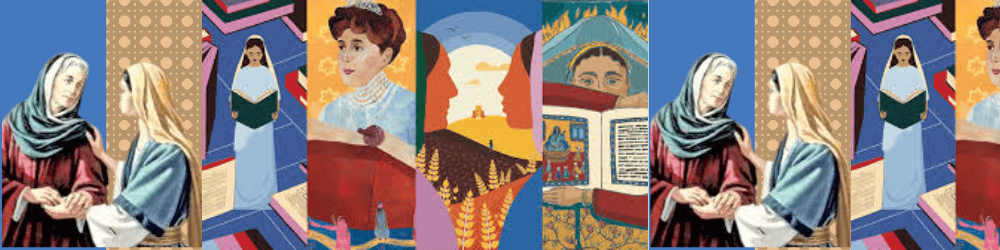
Celebrate the remarkable women who shaped Jewish history! Join 14 talented artists from our community for the opening of “Women in Jewish History” – an exhibition born from shared study, conversation, and creative inspiration. Each original work honors the stories, struggles, and triumphs of women whose legacies deserve to be remembered and celebrated.
Artists
Deb Alpert-Frolkis
Bubbie
A paper quilled art project depicting my grandmother’s journey tells a story of courage, hope, and new beginnings. In the early 1900s, she left her hometown of Berditchev, Ukraine, seeking a better life across the ocean. Like many immigrants of her time, she traveled aboard the RMS Mauretania, a gran steamship that carried thousands to America. After crossing the Atlantic, she arrived in Milwaukee, where she began building a new life.
Through delicate paper quilling techniques—rolling, shaping, and arranging strips of paper—this artwork brings her journey to life. Flowing waves, the towering ship, and a hopeful figure symbolize both the challenges she faced and the resilience she carried. The piece not only honors her personal story but also reflects the broader immigrant experience, capturing the bravery it took to leave everything behind in pursuit of opportunity and a brighter future.
Bio: As a retired educator born and raised in Milwaukee, I have long been rooted in the values and traditions of the Jewish community. After a fulfilling career in teaching, retirement has given me the freedom and opportunity to explore a more personal and creative path. My work reflects both my cultural heritage and my deep connection to Judaism, often drawing inspiration from everyday life and the materials readily available around me. Through this creative practice, I continue a journey of learning—now guided by curiosity, reflection, and the joy of making.
Bonnie Bruch
Naomi and Ruth, but not Orpah
In Ruth 1, we read that the husband of Naomi died in the land of Moab. Naomi’s two sons, the husbands of Ruth and Oprah, also died. Naomi then chose to return to Israel and encouraged her daughter-in-laws to return to their families. In verse 8, Naomi says, “Go back, each of you, to your mother’s home. May the Lord show you kindness, as you have shown kindness to your dead husbands and me.”
Initially, both Ruth and Orpah refused, saying “We will go back with you to your people”. Naomi then argued that she could provide no more husbands for Ruth and Orpah. From Naomi’s perspective, Ruth and Orpah would remain widowed and childless unless they returned to the homes of their parents. After Naomi’s continued encouragement, Orpah agreed and returned to her family.
Naomi then told Ruth, “Look your sister-in-law is going back to her people and her gods. Go back with her.”
Ruth’s response revealed the difference between Orpah and herself. Ruth said, “Don’t urge me to leave you or to turn back from you. Where you go, I will go, and where you stay, I will stay. Your people will be my people and your G-d, my G-d. Where you die, I will die, and there I will be buried. May the Lord deal with me, be it ever so severely, if even death separates you and me.
This response reveals an important detail about Ruth. In the first statement, in which Ruth and Orpah both said that they would return to Israel with Naomi, they said they would return to “your people”. But when Ruth answered this second time, she also added that Naomi’s God would be her God. She agreed to live with Naomi’s people and to follow the Lord.
Naomi and Ruth returned to the humblest of circumstances, yet God used this situation to work in a remarkable way. Ruth would not only join Naomi’s people, she would later marry one of Naomi’s relatives and give birth to a son named Obed—-who became the grandfather of King David.
Ruth’s response is a powerful example of how we are to give allegiance to God even when we do not know what the future holds. When we surrender to Him, God sometimes works in unexpected ways to show His power and reveal His love.
Bio: Bonita Bruch (also called Bonnie) is a Milwaukee visual artist who strives to create painterly, stylistic portraits of people caught unaware in a moment of time…moments we all experience. She began creating paintings with conte crayons and pastels. Most of her portraits are developed from 5, 10, 15-minute sketches. Her portraits are soft and muted. About 15 years ago, Bonita began painting landscapes with acrylic paints. With this art medium, her style became different. She found herself painting bold, loud, noisy and sometimes quite sassy.
Bonita attended Layton School of Art (replaced now by the Jewish Home & Cafe on North Prospect Avenue) in the mid 1960’s and later earned her bachelor’s degree in art from UWM. She is a member of the Wisconsin Pastels Artists, Wisconsin Visual Artists, and RiverWest Artists Association.
Jacqueline Cabessa Redlich
Flame
A Triology of Faith, Courage, and Belonging
In my series, I explore the stories of three powerful women in Jewish history, each embodying leadership and motherhood rooted in love. The fourth figure represents the universal Jewish woman, a spiritual mother, leader, and nurturer. Called a “mother in Israel,” Deborah was protective, and visionary, guiding her people with wisdom and courage. Henrietta Szold profoundly inspired me: she founded Hadassah and Youth Aliyah, rescuing children from Nazi-occupied Europe and earning the title “mother of Youth Aliyah.” Hannah Szenes, a young poet and soldier, demonstrated heroism born of spiritual love, famously declaring, “He who has not lived for others has not lived at all.” Each of these women exemplifies maternal, selfless devotion.
Bio: Growing up in Paris, France, I developed a profound appreciation for various forms of artistic expression—fashion, painting, architecture, and poetry. These influences became the foundation of my distinctive painting style – one that celebrates balance, harmony, and the uplifting power of art. At the core of my work is a simple yet profound message: art should be a source of comfort and joy. It should evoke feelings of calm, peace, friendship, and unity. My work integrates elements of fashion, real or imagined architectural designs, and lyrical inspirations from songs, poetry, or prayers. Through vibrant and harmonious color palettes, smooth brushstrokes, and flowing lines, I strive to create a visual language that radiates warmth, kindness, and quiet happiness. Each piece is an invitation to pause, reflect, and embrace a moment of light and inspiration. Henri Matisse captured my artistic philosophy best in Notes of a Painter: “What I dream of is an art of balance, of purity and serenity… a soothing, calming influence on the mind, rather like a good armchair which provides relaxation from physical fatigue.” In essence, my artistic mission is to create art that is beautiful, accessible, and healing.
Jonathan Ellis
Rosanne Barr
Bio: Born and raised in Bayside, Wisconsin. A devoted visual artist from childhood, educated at SAIC, School of the Art Institute of Chicago, Jonathan Ellis has a prolific body of work and unpredictable contemporary style rooted in emergent truth, love, humor, and theory. His drawings, paintings and sculptures are reflective of a refined artist exploring identity and life itself as a creative act. Self portraits, landscapes, conceptual abstracts, dada and surrealist pieces are regularly transformed, again and again throughout many years, like stories evolving over the course of a lifetime. What is to be found in all is a voice, a vibrant confirmation of life and beauty, a positivity that has emerged out of profound struggle, and the pure joy of Being. Jonathan nurtures community building through social engagement, exhibitions and free-painting events that are both healing and inspirational at his Studio/Gallery- Gallery 1033, on Historic Mitchell Street in Milwaukee, Wisconsin.
Aura Mallick Hirschman
Mamashena Mein
Ode to Lizzie Black Kander: Creator of the Settlement Cookbook
Bio: In the spring of 2024, I audited a course on folk art at UWM, curious whether my own mosaics might fall into that category. Despite all I learned, I still don’t fully know the answer—and perhaps that ambiguity is part of my journey as a self-taught artist who has been creating mosaics for nearly 15 years. I work largely with repurposed materials, drawn to the tactile, colorful, and endlessly diverse possibilities that mosaics offer. My materials are unconventional—found objects, salvaged tiles, broken ceramics—each piece carrying its own history before finding new life in my work. The process itself is joyful, messy, and cathartic, and that sense of joy infuses the work. My mosaics tend toward the whimsical and celebratory, inviting viewers to discover delight in unexpected places. Creating mosaics allows me to transform the discarded into something meaningful and beautiful. Each piece is a puzzle, a meditation, and an act of creative optimism. Whether practical, decorative, or simply playful, my work reflects a belief in the beauty of reinvention and the pleasure of making something whole from scattered parts. I am delighted to highlight a Milwaukee Jewish Woman, Lizzie Black Kander, whose organization began in the 1880’s, The Settlement House’s mission was to settle new immigrants to Milwaukee (largely Jewish). The Settlement Cookbook was originally created in 1901 as a fundraiser for this effort. It became an international best-selling cookbook, after multiple publications up to 1991.
Kate Mann
“Dances rushed forth from the earth like wildflowers after a rain.”
(Seeing Israeli and Jewish Dance p. 111.)
This mosaic piece “Dances rushed forth from the earth like wildflowers after a rain.” honors Rivka Sturman (1903–2000), a pioneer of Israeli folk dance whose life was rooted in the joy of building community through movement.
Trained in modern dance in Germany, she understood the body as a vessel for both personal and collective expression. In 1929, she immigrated to Palestine with her husband and joined a kibbutz, where agricultural life shaped daily rhythms. There, she discovered that teaching dance to young people could help cultivate connection and community in this emerging culture. Together with her students, Rivkah Sturman created new dances inspired by nature—growth, harvest, and Jewish holidays. Her choreography flourished and spread throughout Israel and Jewish communities worldwide.
Among her prolific works are HaGoren (The Threshing Floor), Harmonica, Debka Gilboa, Hineh Ma Tov, and Zemer Atik.
In this mosaic, fragments of broken china and glass come together to form a dancer—echoing Sturman’s own process of gathering individuals into a unified whole. As her dances weave people into community, these bits and pieces, once separate, are reassembled into movement and the memory of the enduring joy of their maker, Rivkah Sturman.
Bio: I have been dancing through life long before I ever set foot in a studio. I grew up in a family of music lovers and art makers, where our parents encouraged each of us to discover our own creative voice. Mine was dance—the joy of expressing music with my whole body.
That early passion carried me into years of studying modern dance, performing, and ultimately earning a BFA in Dance. I went on to build a deeply fulfilling career as a teaching artist and creative Jewish educator, developing innovative ways to engage students through movement, music, and dance.
Dance has remained a constant companion—ever evolving, adaptable, and always leading me in new directions. Recently, that path has taken an unexpected turn. I now find myself not in a studio or classroom, but in my basement, standing at my father’s old wooden worktable. With tile nippers in hand, I cut fragments of broken china and glass, assembling them into vibrant mosaic images of dancers—still moving, even in stillness.
Sarah McCutcheon
Lizzie Black Kander: Visionary
Lizzie Black Kander was a visionary leader in Milwaukee whose passion for cooking, education, and social reform helped immigrant families build healthy and stable lives. Through her work with settlement houses and the creation of the Settlement Cook Book, she used food as a tool for empowerment, teaching practical skills that strengthened homes and communities. Her legacy of compassion, learning, and community care continues today through the work of the Jewish Community Center of Milwaukee, which carries forward her commitment to nourishing both people and community.
Bio: For more than fifteen years, the Jewish Community Center of Milwaukee has been a place where my personal passions and professional purpose have grown together. I began my journey here as an aquatics instructor, later became a Gan Ami educator, and now serve as the Director of Disability Inclusion. Throughout these roles, I have been inspired by the JCC’s commitment to building community, creating belonging, and supporting people of all abilities. Outside of work, I find joy in gardening and cooking—activities that ground me, nourish others, and connect people around a table.
In creating this piece, I felt a deep connection to the legacy of Lizzie Black Kander, whose work used food, education, and community care as tools for empowerment. Like Lizzie, I believe that simple, everyday acts—sharing a meal, growing food, teaching skills—can transform communities and strengthen relationships. This artwork reflects that shared spirit, blending imagery of food, learning, and community to honor her influence and celebrate the continuing mission of the JCC to nurture connection, dignity, and opportunity for all.
Stephen Pevnick
My Woman of Valor
A photograph of my wife, Laurie taken on July 21 2017 on the patio south of our home in Glendale on a rainy day. It was enlarged and enhanced using Firefly 2xUpscaler, an AI feature of Adobe Phtotoshop and other image and filter tools. It was printed on a wide format Canon Digital printer. C Stephen Pevnick March 20. 2026. Thanks for technical support to Gershie Pevnick.
Bev Richey
“Uninhibited” Homage to Lee Krasner
“Uninhibited” : Expressing one’s feelings or thoughts unselfconsciously and without restraint”
Developing a process to release expression is at the heart of the Abstract Expressionists. Early on in my painting project I developed an interest in Lee Krasner’s work. This Jewish woman artist developed her expressive impulse using both line and color. It is fitting for me to share a work of my own which has incorporated essential process values of her work.
Bio: I joined the Midwest Jewish Artists Laboratory in 2014. This project was conceived by JCC Jewish Educator Jody Hirsh and generously funded by the Covenant Foundation. Jody realized that while there were numerous Jewish Artists living and working in the greater Milwaukee area, they frequently did not know each other. The laboratory program was designed to create connections with in the local Milwaukee Jewish community and to spread the connectivity through out the Midwest, creating the Midwest Jewish Artists Laboratory.
Funded for two funding cycles, a total of eight years, with the end of it’s second round of funding coinciding with the beginnings of covid, Milwaukee Jewish Artists lost their newly developed home base. With my personal background in arts administration and organizing artists I understood the need to reimagine a way to sustain our community of visual artitsts with a focus on bottom up in addition to top down.
After nearly five years of grassroots organizing with support from our Milwaukee Chabad Community, the Jewish Artists are reemerging as a community of creative friends. These kinds of friendships are critical to the over all health of creative communities. The love, support and overall quality of life for artists and patrons is directly connected to it’s ability to function as a community. I remain committed to participating in the Jewish Artists community on multiple levels and will continue to do so.
Barbara Schaefer
High Noon
“Shulamit Ran (b. 1949, Tel Aviv) is a world-renowned, contemporary Israeli-American composer and my chosen Jewish heroine. In particular, her musical composition Under The Sun’s Gaze (2005) inspired my painting High Noon (2026). Ran’s music treats light as a transformative force – one that fractures, bends, reshapes and empowers the materials it touches. My paintings operate similarly: As forms and colors drift and dissolve and atmospheric fields exert their own quiet pressure, there is a balance between control and spontaneity that settles into unexpected harmony.”
Bio: Barbara Rae Schaefer (b. 1950, Duluth, MN) is a Milwaukee-based visual artist whose work explores fluid movement, color layering, and the emotional resonance of organic lines and forms. Her work reflects a deep interest in material experimentation and the sensory impact of color and has always been influenced by the rhythms, sounds and silences of music – past, present and around the globe. She holds a BFA in painting from the University of Minnesota (1972), and an MFA in painting from Pratt Institute, Brooklyn, NY (1974). Barbara has exhibited her work in numerous galleries and museums throughout the United States and abroad and continues to expand her practice throughout regional, national and international art communities.
Jessie Schwade
Queen Esther
Queen Esther of Persia is celebrated for her courage, wisdom, and selfless devotion to her people. Though placed in a position of great privilege, she risked her own life standing up for justice, and changing the destiny of the Jewish people.
Bio: Jessie enjoys making art of all kinds, most recently stained glass, mosaics, quilting, pressed flowers in epoxy resin. She is a retired RN, BSN with an MS in Counseling.
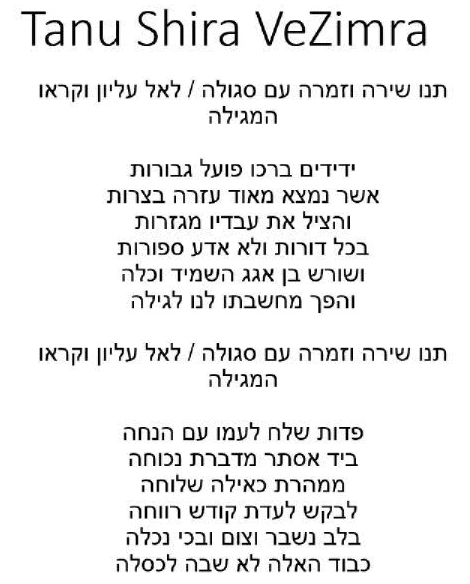
Click here to read the Piyut (liturgical poem) retelling (shorting) the story of Queen Esther and Purim. Written in Iran(Persia)/Kurdistan in the 1500’s it starts: “Give song and praise oh virtuous G-d and let us read the Megillah.”
Rebecca Targ
Annie Shapiro
Hannah “Annie” Shapiro was the artist’s great aunt. Annie started working at age 13 after arriving in Chicago with her large family from Ukraine, and at age 18 she lead a walkout of Shop No. 5 at men’s garment manufacturer, Hart, Schaffner, and Marx. This action encouraged a city-wide strike of garment workers asking for respect, fair wages, and safe working conditions. The walkout grew to 40,000 mostly immigrant workers and encouraged strikes in Milwaukee, as well. When interviewed later, Annie said: “We all went out; we had to be recognized as people.”
Bio: Rebecca Targ is a disabled interdisciplinary visual artist, writer, and educator. Her interests as an artist and designer involve the concepts of editing, systems, collaboration, translation, indexing, and communication.
Rebecca has a BFA in Painting and a BA in East Asian Language and Literature from Indiana University and an MFA in Visual Communication from The School of the Art Institute of Chicago. She was formerly a university professor in the area of graphic design with a special interest in teaching process, conceptual thinking, and typography, and loved working with students.
Rebecca interacts with her Judaism by supporting peace and justice work and being with her family.
Melanie Wasserman
In Eternal Jewish Woman
The Shabbat Queen
My work explores the sacred, generative power of the Jewish woman as both a spiritual conduit and a living presence within the home. Through layered materials—glass, ceramic tile, fabric, paper, and fragments of broken jewelry—I construct visual images that convey continuity, transformation, and divine embodiment .
The Shabbat Queen (mosaic on wood) draws from the mystical concept of Shabbat Hamalka, the Sabbath Queen, a feminine spiritual presence welcomed each week. In this piece, the Sabbath candles represent their lighting which is an act of invocation: not only a ritual of repetition, but also one of transformation. The Jewish woman emerges as a vessel of illumination, drawing holiness from the unseen into the physical world.
In Eternal Jewish Woman (paper and fabric collage on wood board).
Rooted in theology and Kabbalah, the woman is understood as a “kli”, a vessel not only of life but of soul. This work reflects on the unseen dimension of creation: the shaping of identity, the transmission of essence, and the formation of the “Divine Spark.” Through soft textures and layered forms, I evoke the interior space where spirit and body converge, where identity is not only inherited but cultivated.
Together, these works honor the Jewish woman as both origin and bridge—between generations, between the material and the divine.
Questions? Contact Reva Fox, Arts & Culture Director