What Kids Center Learned at America's Black Holocaust Museum
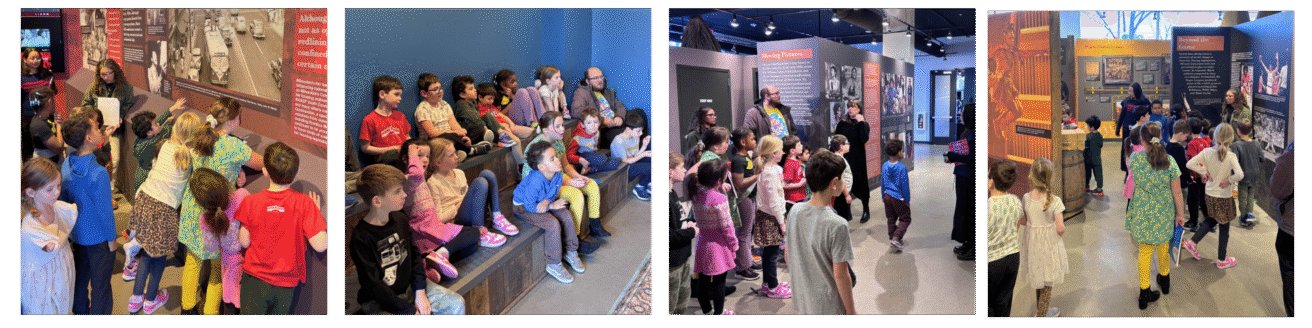
Recently, our Kids Center Vacation Days group took a field trip to America’s Black Holocaust Museum (ABHM) in Milwaukee’s historic Bronzeville neighborhood. The tour was designed with young visitors in mind, moving through age-appropriate exhibits, and making plenty of room for questions. After the tour, the kids gathered to talk about what they’d seen and learned.
“There were two colors on the tour: black and yellow. They both led to different parts of history. The Mona Lisa was in black, because it’s a part of history that a lot of people know about. The castle in Africa is in yellow, because it’s a part of history that not a lot of people know.” – Kids Center participant
That observation is really the whole mission of ABHM. The museum exists to bring lesser-known history into the light and ask us to hold it with the same care as the history we already know. It’s exactly the kind of thinking Ronna Ruffin, our Director of Youth Programs, was hoping to spark.
“Ever year, we look for ways to make Black History Month meaningful for our kids – not just educational but engaging. A visit to ABHM does both, and as a Jewish community, the connection runs deeper than we might expect.”
About the Museum – and its name
As a Jewish community, the world Holocaust carries deep meaning for us, tied to our own history of loss and survival. So it’s worth understanding why Dr. James Cameron, ABHM’s founder, chose that name – because his reasons are rooted in respect, not comparison.
Dr. Cameron was sixteen years old when a mob in Marion, Indiana, dragged him and two friends from a jail cell. His friends were lynched, but Dr. Cameron survived. He spent the rest of his life determined to make sure that history – and histories like it – would never be forgotten.
The inspiration for the name came directly from a visit to Yad Vashem, the Holocaust memorial museum in Jerusalem. Dr. Cameron was moved by the Jewish community’s commitment to memory – the conviction that teaching the world about the Shoah is the surest way to prevent such atrocities from happening again. He saw in that mission a mirror of his own. He wanted the same gravity and moral seriousness applied to the 400-year history of slavery, lynching, and racial terror in America.
The parallels Dr. Cameron drew were not abstract. The history of enslaved Africans and their descendants – and the oppression they faced – shares common roots with the persecution of Jewish people throughout history, including during the Holocaust. Racism and antisemitism take different forms, but they grow from the same seed of hatred.
The Jewish Values that Connect us
When we look at ABHM’s mission, we see values that feel very familiar. The museum is built around four themes: Remembrance, Resistance, Redemption, and Reconciliation. These aren’t far from the principles that guide us as a Jewish community.
Zachor (remembrance) is a sacred obligation in Jewish life – we are commanded to remember not just as a historical exercise, but as a moral one. Tikkun Olam (repairing the world) calls us to take action against injustice, not just within our own community but in the broader world. B’tzelem Elohim (all are made in the Divine image) reminds us that every person deserves dignity and respect, without exception. And L’dor vador (from generation to generation) is exactly what ABHM practices – history carried forward through storytelling, so the next generation inherits not just the past, but the responsibility that comes with knowing it.
ABHM even uses a special word for its guides that reflects this: griots, the oral historians of West African tradition who carry community memory from place to place through story. It’s a different word, but a deeply familiar idea.
Our kids felt that connection, too (sometimes in unexpected ways):
“Mansa Musa – we couldn’t remember how to say his name, but it sounded like Matzah – was a Black ruler in Africa who had a lot, a lot of money. He gave his money to help a lot of people.” – Kids Center participant
We’re glad Kids Center had the chance to spend a day at ABHM. The conversations it sparked – about fairness, memory, and treating people with kindness regardless of who they are – are exactly the kind of conversations we want our kids to be having.
Beyond the swimming, gym time, and themed activity days, Kids Center Vacation Days are designed to get kids out into their community and engage with the world around them. Open to kids in grades K4-6th, Vacation Days are available to both JCC members and community families. Spring Break Camp registration for JCC members is already open; community registration opens Monday, March 2. Learn more and register here.